Print-on-demand quietly removed one of the biggest financial risks in book publishing: printing thousands of copies before knowing whether anyone would buy them. Understanding what print-on-demand publishing actually is, and how it actually works, explains why it’s become the default choice for most self-published and many hybrid-published books today.
What Print-on-Demand Actually Means
Print-on-demand (POD) means a physical copy of a book is printed only after a customer orders it — one at a time, as needed — rather than printed in bulk in advance. When a reader buys a copy, the order triggers a printing run of exactly one book, which is then bound and shipped directly to that reader, often within a day or two.
How the Process Actually Works
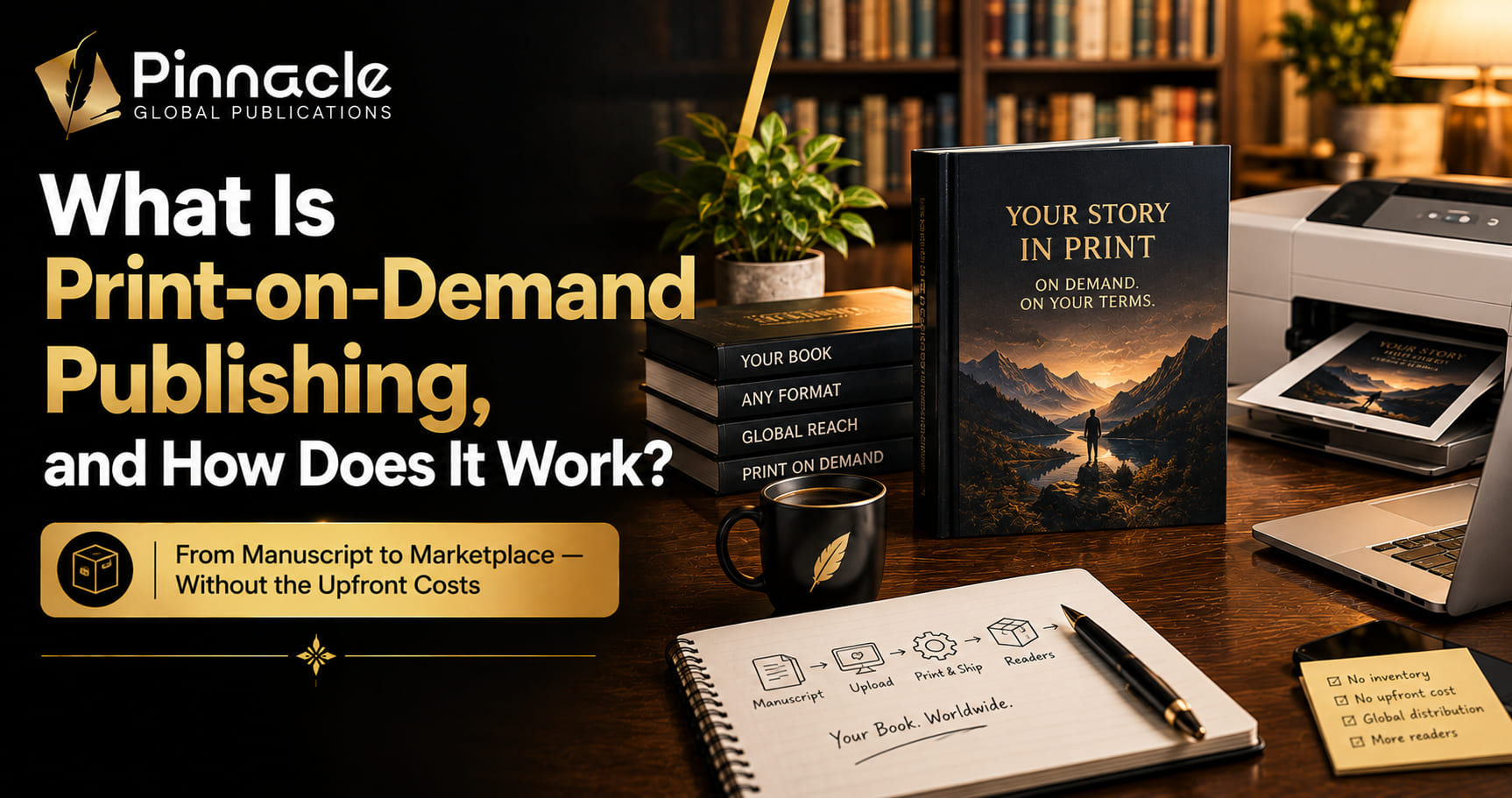
- The book is formatted and uploaded to a POD platform (Amazon KDP, IngramSpark, and similar services) as a print-ready file, along with cover art sized to the exact specifications.
- The listing goes live on the retailer or distributor’s platform, appearing searchable and orderable even though no physical copies exist yet.
- A customer places an order. This triggers the platform’s printing system, which prints, binds, and packages that single copy specifically for that order.
- The copy ships directly to the customer — the author or publisher never handles physical inventory at any point in this chain.
Why This Matters for Authors
- No upfront printing costs. Traditional offset printing requires paying for a print run — often 500 to several thousand copies — before a single sale happens. POD eliminates that entire upfront cost.
- No inventory or storage. There’s no garage full of boxes, no warehousing fees, no unsold stock to manage or eventually discard.
- Books never go out of print. As long as the file remains active on the platform, a copy can always be printed and ordered — there’s no concept of a POD book selling out or becoming unavailable.
- Lower financial risk overall, since an author isn’t betting a large upfront sum on uncertain sales.
The Tradeoffs Worth Knowing
- Higher per-unit cost. Printing one book at a time is inherently more expensive per copy than printing thousands at once, which means lower profit margin per sale compared to a successful offset print run.
- Fewer bulk discount opportunities. Buying author copies for events or bulk sales is more expensive per unit through POD than ordering a bulk offset print run.
- Bookstore returns policies. Traditional bookstores are used to being able to return unsold inventory to a publisher; not all POD providers support this, which can make some bookstores hesitant to stock POD titles without that safety net.
- Slightly less print quality control in some cases — though quality has improved substantially, and many POD books are visually indistinguishable from offset-printed ones today.
Print-on-Demand vs. Offset Printing
Offset printing is the traditional bulk method — a printing plate is created and a large run of identical copies is printed at once, driving the per-copy cost down significantly at volume, but requiring a substantial upfront investment and a place to store the copies until they sell. POD flips this entirely: no upfront investment, no storage, but a higher cost per individual copy. For a first-time author with uncertain demand, POD’s lower risk usually outweighs the higher per-unit cost. For an author with a proven, predictable sales pattern (often after a successful first printing run or a strong pre-order campaign), offset printing can become more economical at meaningful volume.
Why Print-on-Demand Changed Self-Publishing
Before POD technology matured, self-publishing meant either paying a vanity press for an expensive bulk print run of dubious value, or navigating offset printing logistics entirely alone — sourcing a printer, negotiating minimums, financing the run, and figuring out warehousing and fulfillment. That combination of cost and complexity kept self-publishing largely inaccessible to most authors. POD removed nearly every one of those barriers at once: no printer relationship to negotiate, no minimum order, no warehouse, and a total upfront cost that could be close to zero beyond the book’s own production (editing, design, formatting). This is the single biggest reason self-publishing shifted from a niche, expensive option to a mainstream, viable path for most authors.
Who Print-on-Demand Is Best For
- First-time authors with no sales track record, where demand is genuinely uncertain and a large upfront print investment carries real financial risk.
- Backlist and niche titles with steady, modest demand rather than a big anticipated launch spike — POD suits slow, sustained sales far better than bulk printing does.
- Authors testing a concept before committing to a bigger production or marketing investment, since POD lets a book go live with minimal financial commitment.
Who Might Outgrow Print-on-Demand
- Authors with a proven, predictable sales pattern — once demand is established, the per-copy savings of an offset run can outweigh the convenience of POD, particularly for a planned book launch with strong pre-orders.
- Authors pursuing significant bookstore placement, where offset printing’s returns-friendly terms are sometimes a meaningful advantage with traditional retail buyers.
- Books with complex physical production needs — specialty bindings, unusual trim sizes, or premium paper stocks that POD platforms may not support well, where a traditional printer offers more production flexibility.
Many successful authors actually use both over a book’s lifecycle: POD for the initial launch and ongoing steady sales, with a bulk offset run reserved for a specific event, a bookstore order, or once sales data clearly justifies the larger upfront investment.
What Print-on-Demand Typically Costs
The per-copy cost depends on trim size, page count, color vs. black-and-white interior, and binding type, but a typical 300-page black-and-white paperback novel commonly costs $3-6 per copy to print through most major POD platforms. That cost is deducted from the sale price before any royalty is calculated, which is why understanding print cost matters directly for setting a viable retail price — pricing too low relative to the print cost can leave little or no margin per sale.
Choosing a Print-on-Demand Platform
- Amazon KDP integrates tightly with Amazon’s retail ecosystem, generally offers the lowest print costs, but distributes primarily through Amazon itself.
- IngramSpark connects to a much broader distribution network reaching thousands of retailers, libraries, and bookstores, with somewhat higher print costs and setup fees in exchange for that wider reach.
- Using both — a common strategy — captures Amazon’s lower costs and dominant retail volume while still reaching the wider bookstore and library network IngramSpark provides.
Frequently Asked Questions
What is print-on-demand publishing? A printing model where a physical book is printed one copy at a time only after a customer orders it, rather than printed in bulk in advance — eliminating upfront printing costs and inventory.
How does print-on-demand actually work? An author uploads a print-ready file to a POD platform; when a customer orders a copy, that single copy is printed, bound, and shipped directly to the customer, with no physical inventory held by the author or publisher.
Is print-on-demand more expensive than traditional printing? Per copy, yes — offset printing is cheaper per unit at volume, but requires a large upfront investment POD doesn’t. For most first-time authors, POD’s lower risk outweighs the higher per-copy cost.
Can print-on-demand books get into physical bookstores? Yes, particularly through wide distributors like IngramSpark, though some bookstores are more hesitant to stock POD titles that don’t support standard return policies.
Do print-on-demand books look as good as traditionally printed books? Quality has improved substantially and most readers can’t tell the difference — though it’s worth ordering a physical proof copy before finalizing, since quality can vary somewhat by provider and file specifications.
Do I need different print-ready files for different POD platforms? Often yes, at least in minor ways — each platform has its own trim size options, margin requirements, and file specifications, so a file formatted correctly for one platform may need adjustment before uploading to another.
Can I set my own retail price with print-on-demand? Yes, within a minimum set by the print cost plus the platform’s required margin — you can’t price below what it costs to print and distribute the book, but you have flexibility above that floor.
Is print-on-demand only for paperbacks? No — most POD platforms also support hardcover printing, though hardcover POD costs more per copy and has historically had a narrower selection of binding and cover finish options compared to paperback.
Getting Your Book Printed the Right Way
Print-on-demand has made professional-quality printing accessible without the financial risk that used to gatekeep traditional publishing. Our book printing team can help you set up print-on-demand correctly across the right platforms for your goals, or advise on when offset printing might actually serve your book better. Reach out to talk through the right printing strategy for your specific book.