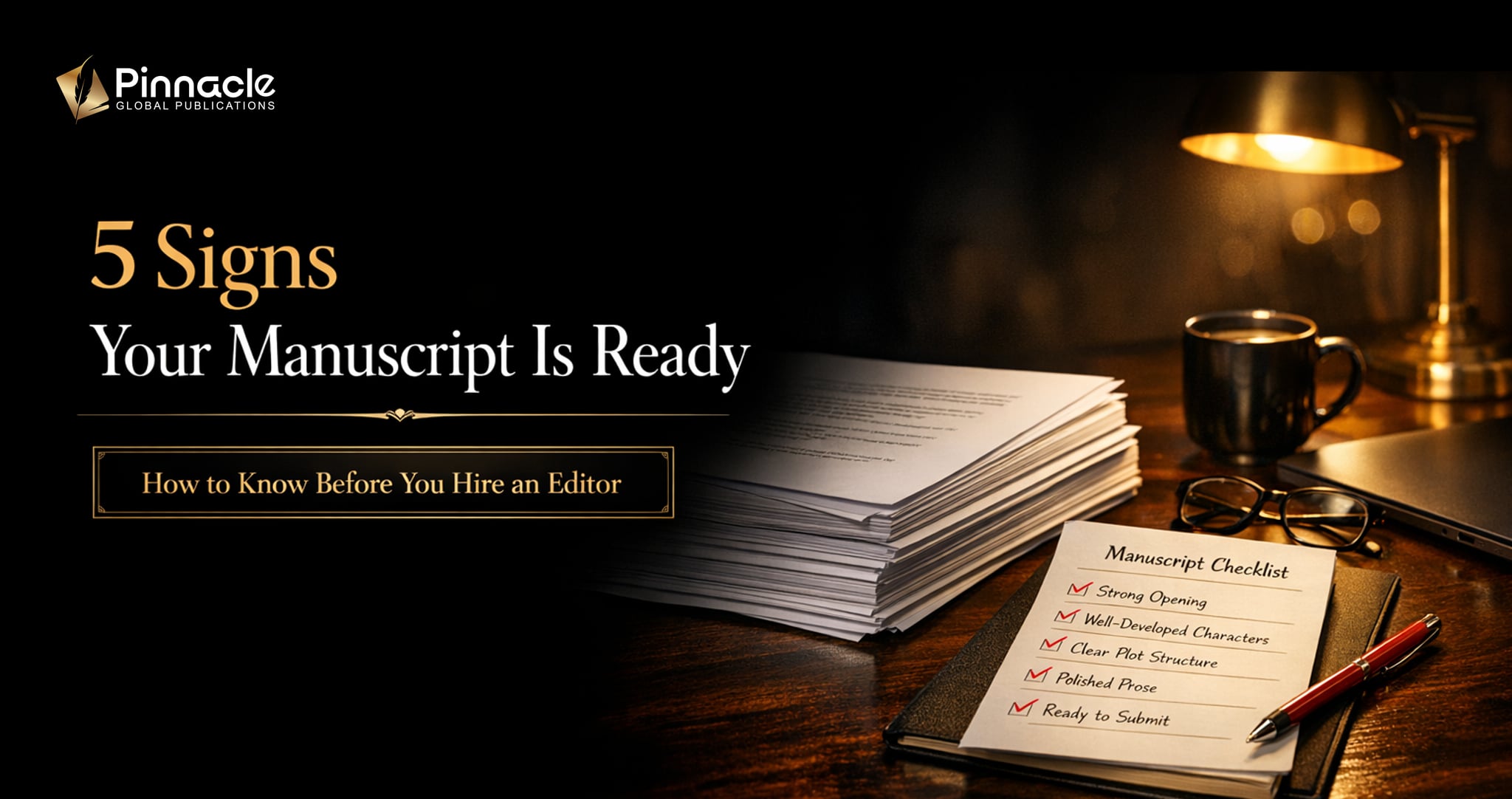
One of the most common questions we hear from first-time authors isn’t “how do I find an editor” — it’s “is my manuscript ready for editing yet?” It’s a fair question, and getting the timing wrong costs real money: send a manuscript to a professional editor too early, and you’ll pay for detailed notes on scenes or arguments that get cut entirely in your next revision. Wait too long, second-guessing every sentence yourself, and you can spend months polishing prose that a developmental pass might restructure anyway.
There’s a middle point where a manuscript is genuinely ready — not perfect, but ready — and these are the five signs that tell you you’ve reached it.
Sign 1: The Manuscript Is Actually Complete
This sounds obvious, but it’s the most commonly skipped step. “Complete” means every chapter exists in some form, the story or argument runs from beginning to end, and there are no placeholder notes like “[insert scene here]” or “[expand on this point later]” still sitting in the text.
A manuscript with gaps isn’t ready for professional editing, because an editor working on it either has to guess what belongs in the missing pieces or simply can’t evaluate whether the whole thing works. Finish the draft first, even if it’s rough. A complete rough manuscript is a better editing candidate than a polished but partial one.
Sign 2: You’ve Done at Least One Full Self-Revision
Professional editing is expensive per word, which makes it the wrong tool for catching things you could catch yourself. Before hiring anyone, read your own manuscript start to finish at least once, ideally after letting it sit untouched for a few weeks so you can see it with fresh eyes. Fix the obvious problems: scenes that clearly don’t work, arguments that contradict themselves, chapters that repeat information.
This single pass typically eliminates 20-30% of what an editor would otherwise flag, and it’s the difference between paying an editor to tell you what you already knew, and paying them for genuinely new insight.
Sign 3: You Can Describe the Book in Two Sentences
If you can’t summarize what your manuscript is about — its core story, argument, or promise to the reader — in two sentences, that’s a sign the manuscript itself may still be unclear on that point too. This isn’t a marketing exercise; it’s a diagnostic. Manuscripts that resist a clean two-sentence summary usually have a structural or thematic issue that a self-revision pass hasn’t caught, and that’s worth addressing before you pay for a developmental edit.
Sign 4: Beta Readers or a Critique Group Have Weighed In
Outside eyes catch what you can’t see anymore after months of close work on your own manuscript. A small group of beta readers, or a writers’ critique group, reading the complete draft and giving honest feedback is one of the most reliable ready-for-editing signals. If several readers independently flag the same issue — a slow middle section, a confusing timeline, an underdeveloped character — that’s exactly the kind of pattern a developmental editor would also catch, and confirming it yourself first means the paid edit builds on that instead of starting from zero.
Sign 5: You Know What Kind of Editing You Need
“Editing” isn’t one service — developmental editing, copyediting, and proofreading are three different things done at three different stages. If your manuscript still has structural uncertainty (is the story or argument fully working?), it needs developmental editing. If the structure feels solid and it’s the prose itself that needs polish, it’s ready for copyediting instead. Being able to name which one you need is itself a sign of readiness — it means you’ve thought critically about the manuscript’s actual state, not just its word count.
A Genre-by-Genre Note on Readiness
The five signs above apply broadly, but what counts as “complete” and what a self-revision should focus on differs a little by genre:
- Fiction. Readiness usually hinges on plot logic and character consistency — does the story hold together end to end, do characters behave consistently with how they’ve been established, does the ending pay off what the opening promised? A self-revision pass for fiction should specifically hunt for plot holes and continuity errors (a character’s eye color changing, a timeline that doesn’t add up).
- Memoir. Readiness often depends less on plot mechanics and more on whether the narrative arc is clear — what changed, what was learned, why this story matters to a reader who didn’t live it. A common memoir issue caught in self-revision is chapters that read as a chronological list of events without a throughline connecting them.
- Business and nonfiction. Readiness centers on argument structure — does each chapter build logically on the last, are claims supported, is there a clear throughline from the book’s central thesis to its conclusion? Self-revision here should focus on cutting repetition (nonfiction drafts often restate the same point three different ways across chapters) and checking that examples and case studies actually support the point being made.
Whatever the genre, the underlying test is the same: has your own careful read caught what you’re capable of catching, leaving only what genuinely needs a professional, outside perspective?
A Quick Self-Check Before You Reach Out
If you want a fast gut-check beyond the five signs, ask yourself these three questions honestly:
- If I opened this manuscript today after not looking at it for a month, would I find major gaps, or mostly small wording choices?
- Have at least two people outside my own head read the complete draft and given me specific feedback, not just general encouragement?
- Am I revising because something is still genuinely broken, or because I’m nervous about handing it off?
That last question matters more than it might seem. A significant number of “not ready yet” manuscripts are actually ready — the hesitation is about the vulnerability of outside feedback, not a real flaw in the manuscript. Recognizing that distinction is itself part of knowing your manuscript is ready for editing.
What Happens If You Send It Too Early
Editing a manuscript before it’s ready doesn’t just waste money — it can be actively discouraging. Developmental notes on a first draft that still has major gaps often come back extensive and overwhelming, not because the book is bad, but because the manuscript wasn’t finished enough to evaluate properly yet. Authors sometimes read that kind of feedback as “my book doesn’t work” when the real message is “this draft isn’t done yet.” Finishing the draft, revising once, and getting outside feedback first avoids that entirely.
What Happens If You Wait Too Long
The opposite mistake is real too. Some authors revise the same manuscript for years, convinced it’s still not ready, when in fact it reached a genuinely editable state long ago. If you’ve done a full self-revision, gotten beta feedback, and you’re mostly making small word-level changes rather than structural ones, you’re not learning anything new by continuing to revise alone — that’s exactly the point a professional editor starts adding value you can’t add yourself.
A Realistic Timeline From “Done” to “Ready”
For a sense of how long this stage typically takes: finishing a complete first draft to the point where all five signs are true usually takes another four to twelve weeks beyond “The End” — roughly two to four weeks for a self-revision pass, two to four weeks for beta readers or a critique group to read and respond, and a week or two to sit with that feedback and decide what to act on before reaching out to an editor. Authors who skip straight from finishing a first draft to hiring a developmental editor are, in effect, compressing that whole process into the editor’s paid time instead of doing it themselves first — which is exactly what makes early editing more expensive than it needs to be.
None of this needs to happen quickly. A manuscript that takes an extra two months to genuinely reach these five signs will get more out of a professional edit, and often cost less overall, than one rushed to an editor the week the first draft is finished.
Frequently Asked Questions
How do I know if my manuscript is ready for editing? Check all five signs above: the draft is complete with no gaps, you’ve done at least one full self-revision, you can summarize the book in two sentences, outside readers have given feedback, and you know which type of editing (developmental, copyediting, or proofreading) it actually needs.
Is it bad to send a rough draft to an editor? It’s not “bad,” but it’s usually inefficient — a rough draft with major gaps generates notes that often get overwritten by your next revision, meaning you may end up paying for feedback twice.
When should I hire a book editor exactly? Once you can honestly check off all five signs above. If you’re only hitting two or three, spend more time revising and gathering outside feedback first — that stage is free, and it makes the paid editing stage far more effective.
What if I don’t have beta readers? Online critique groups, local writing organizations, and even a handful of trusted friends who read in your genre can serve the same function. The goal is simply outside eyes on the complete draft before a professional edit.
Can an editor tell me if my manuscript is ready instead of guessing myself? Yes — many editors offer a manuscript assessment or sample edit specifically for this, evaluating whether you’re ready for a full developmental edit or need another revision pass first, often for a smaller fee than the full service.
Does a manuscript need to be ready for editing before I think about a cover or formatting? Yes — editing comes first in the sequence for a reason. Cover design and formatting are typically done once the text itself is close to final, since a developmental edit can still restructure chapters, and formatting a manuscript that’s about to be reorganized just means redoing that work later.
Getting a Second Opinion
If you’ve worked through the signs above and you’re still not sure, that uncertainty is itself worth resolving before committing to a full edit. A short manuscript assessment from a professional editing team can tell you plainly whether your manuscript is ready for professional editing now, or whether one more revision pass would make the investment go further. That kind of honest read is exactly what separates a manuscript that’s genuinely ready from one that just feels finished.
If you’d like that second opinion before you commit to a full edit, reach out and we’ll tell you directly where your manuscript stands — not what’s fastest to sell you, but what your manuscript actually needs at this exact stage.